
Keeping a food journal is less about calories counted and more about patterns surfaced. Observations on how the act of writing before eating alters eating pace and attention — and why the notebook, kept for awareness rather than restriction, becomes a different document entirely.
What a Journal Records
The conventional food journal is a ledger. It records what was eaten, when, and in what quantity. In the tradition of restrictive eating frameworks, it functions as an accountability document — a visible record of adherence or departure from a plan. The problem with this version of the journal is that it focuses attention on the content of eating rather than its context, and context is where the more revealing information lives.
A journal kept for awareness adds two questions to every entry: what was I feeling before this eating episode, and what was I feeling after? These questions shift the document from a nutritional record to a behavioural one. Over several weeks, patterns emerge that the person could not have reported from memory alone. A consistent entry of low mood in the late afternoon followed by habitual snacking on specific foods becomes visible not because the person was unaware it happened once, but because the journal accumulates the repetition into a pattern that demands acknowledgement.
The journal also captures information about the eating environment. Where was the meal eaten? Was a screen present? Were others eating at the same time? These contextual notes, kept over time, allow a reader of their own journal to see which conditions reliably precede eating episodes that go past fullness, and which conditions tend to produce more considered eating. The environment is often the most consistent predictor, and it is the easiest to alter deliberately.
“The journal does not change the eating. It changes what is known about the eating — and that knowledge is where change becomes possible.”
Eating Pace and the Act of Writing
There is a secondary effect of the pre-meal entry that is worth noting: the act of writing before eating introduces a pause. It requires the person to stop, locate the notebook, form a sentence about their current emotional state, and note the time. This pause — even when it lasts only sixty seconds — interrupts the automaticity that characterises habitual eating. It creates a moment of consciousness between the impulse and the action.
Eating pace matters because fullness signals take time to register. The research on satiety consistently places the lag between physical fullness and conscious awareness of it at approximately twenty minutes. A person eating quickly will have consumed substantially more food than their body required before the signal arrives. Writing before a meal slows the initiation of eating; being aware of the writing practice during a meal can slow the meal itself — not by rule, but because the awareness of being observed (even by oneself) tends to moderate pace.
Several people who have maintained awareness journals for this almanac reported that simply knowing they would write about the meal afterwards changed how they ate it — more slowly, with more attention to the food itself, and with a greater likelihood of pausing mid-meal. The post-meal entry, with its question about fullness, requires the person to have noticed their fullness at some point — which often prompted them to notice it during the meal.
Recognising Fullness Cues
Recognising fullness cues is a skill that atrophies under conditions of distracted eating. When attention is elsewhere — on a screen, in a conversation, on a task — the physical signals of fullness arrive and are not processed. They occur, but they do not reach deliberate awareness. Eating continues until stopped by an external factor: the food is gone, the programme ends, the meeting resumes.
The food journal supports this skill by directing attention to it explicitly. The post-meal question — how full did I feel when I stopped? — requires the person to retrospectively reconstruct whether they noticed fullness during the meal and whether they acted on it. Over time this retrospective enquiry trains a prospective habit: the question begins to arise during the meal rather than only after it.
Mindful portion awareness is the practical application of this recognition: not measuring food in advance, but checking in during eating — at the approximate midpoint of a meal — with the question of whether hunger is still present or whether continued eating is driven by taste, habit, or availability. The journal creates the vocabulary for this check-in. A person who has been writing about fullness for several weeks has the internal language to ask the question. A person who has never considered it may not know what they are looking for.
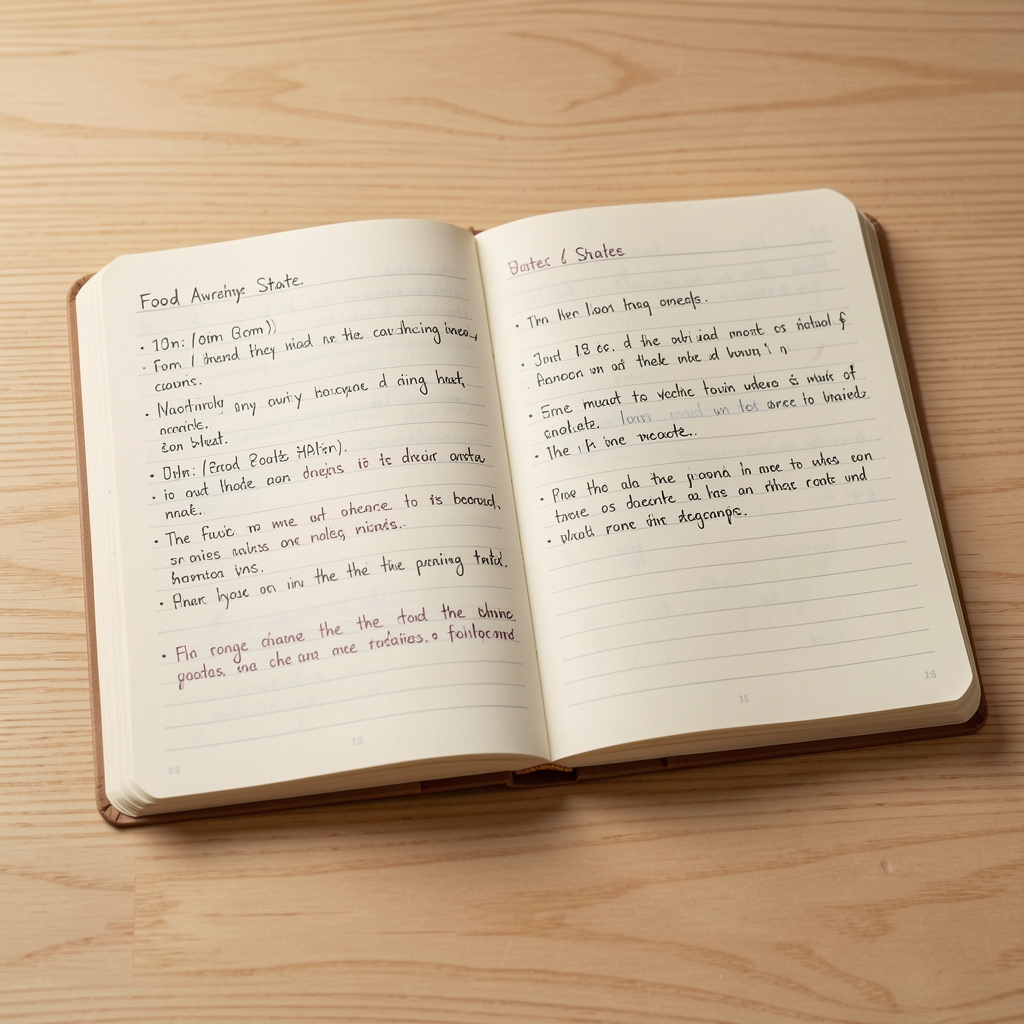
Note the time, current emotional state, and hunger level on a simple scale. Write one sentence about what you expect to eat and why.
Optional mid-meal check: pause briefly and note whether hunger is still driving the eating or whether the meal has satisfied the original need.
Record what was eaten, the eating environment, and fullness level when eating stopped. Note any emotional shift between before and after.
The Awareness Practice
Food journalling as an awareness practice is distinct from food journalling as restriction. The aim is not to reduce what is eaten but to increase what is known about why and how eating happens. A restrictive journal produces guilt when entries show deviation from a plan; an awareness journal produces information about a pattern, which is emotionally neutral and practically useful.
The most consistent finding from people who maintain this practice is that the value lies not in any single entry but in the accumulation. A month of entries, reviewed, shows which emotional states reliably precede the largest eating episodes, which eating environments are most closely associated with eating past fullness, and which days of the week carry the most habitual snacking. This is information that could not be generated by reflection alone — memory is too selective and too subject to recent events to capture the pattern accurately.
The notebook, in this sense, is not a document of failure or success. It is a record of an ongoing relationship between a person and their eating behaviour — a relationship that most people have never examined with any systematic attention. Examined, it almost always contains more predictability than the person expected, which is itself a form of reassurance. The eating is not random. It follows patterns. And patterns, once seen, can be engaged with deliberately.
Articles published on Istara Almanac are editorial in nature and reflect the writers’ observations on everyday wellness practices. The content is not intended as professional advice, nor as guidance for the management of any specific condition. Readers with specific concerns about their daily routines are encouraged to speak with a qualified wellness professional.